Monday, June 30, 2008

Good Roger Federer interview


By Georges Homsi, Tennis.com
Q. Does defeat hurt more when it's so rare, because it's so rare?

ROGER FEDERER: Actually it hurts less, you know. Because you win so much, I think you can take a defeat easier. It's not like you're going to expect a defeat, but because of all the success I've had, a loss here or there will arrive. When it happens, all you can just make sure is that you try your best. And I used to have many matches in the past where I thought, came off court and I felt like, “This wasn't a fight. You could’ve fought more. You could’ve tried harder. You could’ve changed things.” You come off the court and you feel like you have regrets. Today, since let's say four, five years, I don't have those anymore, and this is why they're easier to accept. Because I think you have to be able to handle both things the same way.

Q. Some players are saying, Roger is not going to dominate anymore like he did. It's not like it used to be. Things have changed. Does that do something to you?

RF: Not really, you know. I mean, every player has their own opinions. It's no problem, you know. The only thing is the way probably the press asks the questions as well. They trick the players sometimes and ask them. “We have the feeling it's over. What do you think?” All a sudden, you can create your story you wanted it to be. For me, it's important to come back, you know, and play well now again. I don't think it's a fair statement either, you know, to say something like that, you know, after I just won the Masters, finished again No. 1 in the world and won three Grand Slams and only played two tournaments under bad circumstances in three‑and‑a‑half months and people start questioning if I'm still on top of my game. It's not fair, because I didn't get a chance to really prove myself yet. If I lose the next five matches in a row in the first round, then you can start talking like this, but not yet.

Q. Do you have the feeling that the threat from other players is bigger than ever before?

RF: Well, I think when I came up with the generation of Hewitt and Safin and Roddick and all these guys, I think that was sort of maybe a similar time to what it is today. I mean, that group was very, very strong as well, you know. We had plenty of No. 1s there. If you look back, all of them became No. 1 in the world at some stage, so you have the same thing here. Even though some guys have been strong to enter into the top 10, like maybe Berdych or Baghdatis, to stay there on a regular basis, there's only so many spots in top 10. Our generation’s still strong with Hewitt and Roddick and myself, and Safin unfortunately is struggling a little bit, but Blake is hanging in there, and many of the other guys are always ready for a surprise. For me it was only a matter of time until the juniors will really arrive, and it seems like it's happened really since a year or so.

Q. A guy like Djokovic says, I want his spot. I want the No. 1. Before people used to say, I want to be No. 2 or No. 3, because these guys are untouchable. Does that motivate you?

RF: No, I mean I think Rafa has always wanted to be No. 1 in the world as well. Maybe Novak is just speaking a little bit more loudly about it, you know. He's maybe got that sort of aura around him that people, whatever he says, pick it up in a more aggressive way, I think. Rafa’s always been very down to earth, very low key and this is why it doesn't come across that bad, but he wants it as bad as Novak, for sure.

Q. Go back to when you discovered you had had mono. At that point, it was probably gone. Was that a real relief, say, okay, now I know what I had?

RF: Well, the thing was, I got so severely sick three times that I was like, this is incredible, you know. I'm never sick. I haven't been sick basically the last 10 years, and all of a sudden three times in six weeks. The first time around I was not too worried about it. I just though, Okay, everybody can get sick for few days and you get over it. Second time was before Australian Open, so I went to emergency to check everything out. Then the third time I really thought this is strange, because now I thought it was food poisoning. I ate very healthy, I paid even more attention to everything I did, and I got sick again. When I found out what it was, I was like, “Okay, wow, I heard of people having it. I know it can take a while,” but they told me that I was already towards the end and I had a quite severe mono. This is what sort of made me really, not worried, but I was like, “Wow, how could I then play the Australian Open at all?” Because probably if people would have known, and doctors, maybe they would have told me not to play, you know. So this is sort of what was my biggest scare, a little bit. When I did the next test back in Dubai and they told me actually I was over it, building antibodies and everything, this is then when I felt like, “Okay, I'm fine again because I'm practicing well again.” I just had lack of practice, and that's what my biggest problem was. But that's not a real problem, because most important is health, you know, before everything.

Q. Do you deal with defeat differently than you did five years ago?

RF: Yeah, sure. I was disappointed when I lost in earlier days. I used to cry a lot. I don't know if you remember me, but I was a very sort of a sad person, a very upset person. So it sort of worked me a little bit, you know, just being perfectionist in a way, wanting to win so badly that I would almost ruin my day or my week. And then I used to see other players who would get so, so disappointed or upset. Sometimes they wouldn't speak for a week after. I was like, that's not the way to do it. You know, this is supposed to be fun and this is a dream come true for every player to play on the tour and be challenging the best in the world. So I started to relax a little bit, and I said, “As long as I give everything on the court, that's all I can do.” And once the match is over, you know, a different life sort of starts. This is how I see it now and it’s much better on my mind, absolutely.

Q. What's your first memory of defeat? Maybe juniors, maybe anything that stuck to your mind?

RF: It's hard to say. You know, I mean, I had—I guess the one that really marked me was I think the Squillari match I lost in Hamburg back in 2001. I was upset. I lost 6‑4, 6‑4. Played okay, you know. I just then decided, look, you know what? I cannot continue being like a—acting like some idiot on the court. Just always screaming, throwing my racquet, commentating every shot, just being so emotional. I have to relax a little bit. This is when I then told myself, I have to sort of relax a little bit. Played quarters in Paris for my first time, played quarters in Wimbledon beating Pete. This was really a moment for me when I realized, I have to change. But then the whole change kind of thing took me much, much longer. It was just a switch that I changed, but then it took me most of the year, almost one‑and‑a‑half years, to adapt. But that was sort of a big match for me. And then also the junior U.S. Open final in '98 when I lost to Nalbandian. I went into the match almost being happy with my result already because I had to really battle to get to the finals beating Jerome Haenel and Pless in really tough matches. Got to the finals and was like, “Oh, this is great. I'm just happy.” And then I lost to Nalbandian and I wasn't even upset. I was like, that's not Federer. Federer, he gets upset when he loses, especially when he's 18 years old, you know, 17. This is this also when I then told myself I have to work much, much harder, on my attitude.

Q. And your first significant memory of victory, first one?

RF: First one, big ones were junior Wimbledon, Orange Bowl, and it goes on. I guess first title back in Milan, obviously the Wimbledon win against Pete. But then also I was going to say Davis Cup back in Basel against the Americans. I think it was the first time I ever cried after a match I won, just because of the exhaustion. I won singles, doubles and singles against Americans. It was a big deal. Sort of went like this in phases and phases, and then I guess, you know, sort of my first—I think Hamburg was huge, too, back in 2002. First clay court tournament title. Also then I cried just because I could not—the shock almost. I played in Rome and was so disappointed, I lost in the first round against Gaudenzi, hanging out with Safin and I was like, “I just wish I didn't have to go to Hamburg next week. Can we not skip it and go to Paris?” Next thing we know we're playing each other in the final in Hamburg. It was quite ironic.

Q. Do you still feel you have anything to prove to yourself or to others?

RF: Not to others, really. I think it's more about, not keeping people happy, but more like the fans. I want to show the fans, really, you know, they pay tickets, I'm there to perform, I’m there to entertain. I want to do well for myself, I want to do well for my team who gives its best every day. This is sort of how I see things. Prove to myself that I'm the best, yes. Prove that I want to become part of history in a big way, yes. And this is sort of what I'm looking at. History really is motivating me in a great deal now, actually. I always thought it’s going to put extra pressure on me, playing for history, playing against young guys, playing for myself, the whole thing. But it's become actually the pleasure ride for me, being part of playing for history. It's something very special for me.

Q. You're still very young. Still, do you feel like your body is trying to react differently as a few years ago, whereas after practice it gets tired easier?

RF: Honestly, not in a big way. I think important as an athlete, I think it's to understand your body, how it reacts and how it feels before and after competition and what can happen, what is normal, what is abnormal. So I think this is also way of experience, you know. When you have a lot of muscle pain and you don't understand why you have it, you don't know that it's normal. Sometimes it's normal that you have muscle pain, depending on what you do. And I know exactly what I need to get ready for matches, I know what to treat to feel better, and this is, I think, is a big secret.

Q. Can you talk about the experience and the excitement of the Olympics?

ROGER FEDERER: Well, Olympics is different, because you feel like it's Game Switzerland and not Game Federer. And playing under the flag, it's always a special feeling for me. The Olympic Games being every four years creates extra pressure, it always creates a big juggle in the calendar. Right away it makes it a big priority because of that. And, you know, for me, having met Mirka at the Sydney Olympics, having carried the flag back in Athens in '04, I have had some of the most incredible experiences of my life at the Olympic Games. This is why I’ll always play it as long as I can and I hope I’m going to do well in Beijing.

Q. A lot of players put it behind the Slams. It seems like you almost put it in front.

ROGER FEDERER: It's a tough call. I think it's the same thing for me. Depends, you know. I think it's—it's as big. Let's just put it that way. Some—it depends what you have achieved so far in your career. Because I have won so many Grand Slams, the Olympic Games becomes much, much more important to me than maybe for other players.

Q. What has it been like to get to know Pete Sampras?

ROGER FEDERER: I don't know how you saw Pete and how much you knew him. But for me, I kind of just missed him. He was sort of a ghost on tour for me, you know. Too high, too good to talk to. Sort of, too much respect. And he was gone before I knew it. That was a bit unfortunate. That's why I really enjoyed actually playing against Agassi for so long. So getting to meet Pete, it was above actually playing against him, because I had the pleasure of playing him once at Wimbledon. It was a lot of fun. We had a great time together, I would do it for sure again if the chance comes about. So we'll see if we can do one more exo. I think we got maybe one more exo left in us. Yeah, I mean, he might come out here. So we'll hang around again. We're in contact, and it's nice to sort of have gotten to know him, somebody I admire so much.

Q. Do you feel any bitterness in him that you might break his record?

ROGER FEDERER: No, I think it's in a healthy way, really. I think he would be happy for me. Obviously it's hard for him to maybe let go of those records, but I'm not there yet, you know, so I still have some way to go. I know I have a lot of time, but you never know. That's why I really hope I can make it.

SOURCE: MSNBC

Murray moves on...


LONDON, June 28 (Reuters) - Britain’s sole survivor Andy Murray reached the last 16 at Wimbledon on Saturday after surviving his toughest test yet against German Tommy Haas.

The 21-year-old Scot, seeded 12, played some spectacular tennis to win 6-4 6-7 6-3 6-2 and move into the second week where he will face flamboyant Frenchman Richard Gasquet for a place in his first grand slam quarter-final.

Murray was cruising when he led by a set and a break before a mid-match wobble threatened to silence Centre Court and the massed ranks watching the huge screen on the hill named after Tim Henman, the host nation’s last serious challenger.

After losing the second set on a tiebreak and weathering a Haas storm early in the third, Murray regained the initiative to overwhelm Haas with a succession of flashing winners.

Three times in the past Murray has reached the fourth round at a grand slams and has always come up short but after dropping just one set in three matches so far the Scot is aiming high.

“I want to concentrate on trying to win the tournament right now,” he told reporters. “There’s a big jump obviously from the position I’m in now to getting to the final.

“It’s still three matches away and I’m going to have to beat some really tough players if I want to do that. I’m not really thinking about reaching the quarters. I’m more interested in making it to the final.”

The last Briton to win Wimbledon was Fred Perry in 1936.

LUNGING FOREHAND

A superb lunging forehand pass set Murray on the way to the first break of the match in the third game and that proved enough to take the opening set.

The 30-year-old Haas was barely hanging on to Murray’s coat tails in the second set.

Murray appeared to be toying with Haas, mixing delightful drops shots and lobs with cleanly struck winners. His serve was also regularly topping the 130 mph mark, so it was a complete shock when Haas suddenly turned it around.

The German broke out of the blue after a double-fault let him in and Murray double-faulted again at 4-5 in the tiebreak and then netted a forehand to concede te set.

Former world number two Haas looked dangerous and he twice had the chance to break again at 1-1 in the third. First he put a routine volley wide then Murray cracked down an ace to escape.

Haas wavered in the next game to hand Murray the break and suddenly the momentum switched.

Having moved into a two sets to one lead, Murray produced another improbable forehand pass at 2-2 in the fourth and a couple of points later Haas double-faulted to go behind and this time there was no way back.

“At two all in the fourth he really just played some unbelievable shots and deserved to win,” said Haas.

“He’s going to be tough to beat if he’s playing the way he is, but he’s still got a long way to go.”

SOURCE: Yahoo

Sunday, June 29, 2008

John McEnroe: Andy Murray must avoid anger


There is no one who understands the motivational powers of rage on a tennis court better than John McEnroe. The most furious player to have trodden the turf of the All England Club has offered to act as Andy Murray’s anger counsel-lor in an attempt to bring the best out of the British No 1. “He probably should give me a call and I might be able to help,” McEnroe says.

The three-time champion does not want Murray to lose the feisty edge that leads him to castigate officials, causes television commentators to apologise for the industrial language and makes him one of the most potentially combustible players on the tour. He just wants the Scot to channel his energy in the best direction.

“My anger would be funnelled in a positive manner; his brings negativity,” says the 49-year-old New Yorker. “He needs to figure out a way to use his feelings more positively. When I was winning, I was getting all fired up. He doesn’t seem to be getting so much of that emotion and sometimes we see the anger almost destroy him. We’ve never really had any serious conversations, but, sure, I would talk to him about it, although I have a son older than him, so maybe there’s a generation gap.”

Three fourth-round finishes in 10 Grand Slam appearances hardly testify to the talent that McEnroe and other respected judges see in Murray. Despite winning titles this year in Doha and Marseilles, he has grossly underachieved in the Grand Slams, losing in the first round to eventual finalist Jo-Wilfried Tsonga at the Australian Open, then being sent home from Roland Garros by Nicolas Almagro in the third round.

Each time Murray’s demean-our in defeat was one of a player at odds with himself. Although many sports psychologists and coaches maintain that any displeasure should be masked from opponents, McEnroe says: “I never thought it was a crime to let the opponent know how I was thinking. I can see the argument against that, with Bjorn Borg as the classic example. You’d be thinking, ‘This is unbelievable because this guy is unreadable’. It was not a source of frustration, more amazement, because I could not relate. Sometimes when you wear your emotions on your sleeve it may fuel an opponent who is down and out. Perhaps it has cost me at times when the other player said to himself, ‘I’m going to keep trying because this guy is such a jerk’.”

Such feelings are unlikely to be going back and forth across the net in Murray’s opening match against the 35-year-old French veteran Fabrice Santoro; they have previously announced their mutual appreciation of each other’s talents. After 12 previous visits, this is almost certain to be Santoro’s last competitive visit to the All England Club, and he finally seems set to achieve an ambition of playing on Centre Court. The pair have met once before, towards the end of last season on the indoor hardcourt of Bercy in Paris, with Murray prevailing 6-4 6-2. “He’s a tricky guy to play against,” says the 12th-seeded Scot. “You need to stay focused the whole time because he tries everything and can hit shots that none of the other players can play.”

Murray must hope that his footing is surer than it was on his last grass-court outing at Queen’s, when he repeatedly slipped and stumbled, spraining a thumb. Free from the restraints of an endorsement contract with a shoe company, he has changed brands from adidas to Nike in an attempt to keep his feet.

A practice session yesterday with the seasoned Swede Jonas Bjorkman, who is Santoro’s senior by nine months, left Murray in a confident mood. He insists there will be more marked differences from his last appearance at The Championships two years ago than just a change from three stripes to a swoosh on his feet. Asked to describe improvements he has made since losing to Marcos Baghdatis in 2006, he says: “My net game and positioning is way better. I had good hands at the net, but didn’t quite know what I was doing once I got up there. My first serve, although not having as high a percentage as some others, is a huge weapon when it goes in. And being able to return and come in has been a big difference. I spent too much time a long way behind the base-line, and you get tired after a while. I’m more of an all-round player now compared with the majority of the top players. I counter-punch well and can play aggressive too.”

He insists he is 100% fit after the thumb injury forced him to withdraw from the Artois championships. And he is relaxed before his impending examination by a nation’s fans. “In terms of expectation, I won’t know until I start playing, but in terms of the pressure, it doesn’t feel as bad as it was a couple of years ago,” he says. “It’s been much more relaxed and that’s good. Before, I was taking more of an interest in what was being said in the press and I wasn’t used to people talking about my game. I don’t hate fame, but sometimes, like when you lose a tennis match, you wish no one was bothered with you too much.”

SOURCE: Timesonline.co.uk

Saturday, June 28, 2008

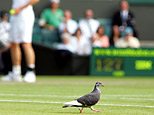
Wimbledon under fire for pigeon cull

Go pigeons! :)
-----------------
LONDON, June 24 (Reuters) - Wimbledon came under fire from animal activists on Tuesday for using marksmen to shoot down dive-bombing pigeons.

The tournament employs two hawks to scare away pigeons who had become a pest swooping down on Centre Court and distracting players in the middle of tense matches.

But the hawks failed to keep the pigeons away from the players’ lawn and the open-air media restaurant so marksmen were called in.

“The hawks are our first line of deterrent, and by and large they do the job,” Wimbledon spokesman Johnny Perkins said.

“But unfortunately there were one or two areas where the hawks didn’t deter the pigeons, so it was deemed necessary to take a harder approach,” he explained.

The marksmen were summoned by Wimbledon as pigeon droppings on the restaurant tables were thought to be a health hazard.

The decision to call in the marksmen was condemned as “cruel and illegal behaviour” by People for the Ethical Treatment of Animals (PETA) which complained to the tournament organisers and the police.

“Since the use of marksmen to kill pigeons appears to have been carried out as a first, rather than a last resort, and not out of a concern for public health, but rather because the animals were deemed inconvenient by players, you appear to be in clear violation of the law,” PETA vice-president Bruce Friedrich said.

SOURCE: Yahoo

Friday, June 27, 2008

Top-seed Ana Ivanovic is ousted at Wimbledon


WIMBLEDON, England - Top-seeded Ana Ivanovic was knocked out in the third round of Wimbledon on Friday by 133rd-ranked Zheng Jie of China, extending a spate of stunning upsets at the All England Club.

ADVERTISEMENT

Ivanovic, who took over the No. 1 ranking after winning the French Open earlier this month, slumped to a 6-1, 6-4 loss to the wild-card entry and doubles specialist.

Ivanovic, who saved two match points before overcoming Nathalie Dechy in three sets on Wednesday, had no answer for the hard-hitting Zheng.

"It's a surprise for me," said the 24-year-old Zheng, who won the Wimbledon doubles title in 2006. "Thanks to Wimbledon, (which) gave me a wild card. I just tried my best and had to keep going, going."

Ivanovic went out a day after 2004 champion and third-seeded Maria Sharapova was ousted by 154th-ranked Alla Kudryavtseva and two-time men's runner-up Andy Roddick was bounced by Janko Tipsarevic. A day earlier, Australian Open champion and No. 3-ranked Novak Djokovic fell to Marat Safin.

Ivanovic committed 17 unforced errors, converted only one of seven break-point chances and lost serve four times. She could lose the No. 1 ranking depending on how far No. 2 Jelena Jankovic and No. 4 Svetlana Kuznetsova advance in the tournament.

The match ended with Zheng's serve hitting the service line and Ivanovic shanking her forehand return into the Court 1 stands.

"She played really well today and it was a tough match for me," Ivanovic said. "I'm disappointed with my loss but I still look at it as a learning experience.

"It was a very emotional last couple of weeks for me and it took a bit of a toll," she added. "I didn't have great preparation."

Zheng has won 11 tour doubles titles, including the 2006 Wimbledon and Australian Open championships with Yan Zi. She has captured three career singles titles, in relatively small events at Hobart in 2005 and Estoril and Stockholm in 2006.

In 2004, Zheng reached the round of 16 at the French Open to become the first Chinese woman to make the fourth round of a Grand Slam. She reached a career high singles ranking of No. 27 in 2006.

SOURCE: Yahoo

Forgot all about this... Classic


By CHARLIE WYETT

Published: 21 Jun 2008

MIKHAIL YOUZHNY wants the Wimbledon docs on stand-by — in case he suffers another rush of blood to the head.

The Russian stunned the tennis world when he smashed his racket against his head THREE TIMES after missing a routine shot — causing the claret to gush down his face.

The world No17 needed treatment on court during his match against Nicolas Almagro in the Sony Ericsson Open in Miami.

Youzhny is now preparing for the first round at the All England Club despite injuring his neck in two places in a freak accident while exercising.

And the Moscow-based fruitcake refuses to rule out a repeat of those madcap antics if he gets stressed during a match.

He said: “When I was a kid I had big problems with my behaviour. It is common among players. One guy who coached me says the older Youzhny is fine but the younger brother Mikhail was crazy.

“I broke rackets and I cried. I’d then shout at my family during matches. Growing older, I changed.

“However, I don’t really like this tournament in Miami. I have never felt comfortable in this tournament. I don’t tend to win matches there.

“I don’t know why. I feel something bad — there is too much negativity around there.

“Before the match I felt negative, during the match I felt negative and after the match I felt negative. I was suffering inside.

“I tried to do my best but I was making so many mistakes. I had break point on his serve, missed the chance and hit the frame against my head a little bit. Three times.”

Laughing about the April incident, he added: “It’s not something I had done before.”

Asked if he’d do it here, he said: “When you watch football and your team is losing, you get the phone and throw it against the wall.

“Some people say they won’t do it again but they watch another match and they do the same thing. It is all about emotions but it is not something I plan to do all the time. But, I can’t say I won’t do it.

“Thankfully in Miami, there was a physio very near. At first I didn’t feel the blood but then I realised I had to go to my chair.

“After that, I felt I had released all the negativity. I won the match.”

Youzhny, 26 on Wednesday, plays Argie Sergio Roitman first up.

The Russian started the year impressively, thrashing Rafael Nadal 6-0 6-1 in India and then reached the Australian Open quarter-finals.

But he has since struggled with his freak injury. He said: “I hurt it while exercising. It restricts me when I raise my arms but I can play.”

SOURCE: The Sun

Thursday, June 26, 2008

Roddick out at Wimbledon!


WIMBLEDON, England (AP)—Sixth-seeded Andy Roddick has been upset in the second round at Wimbledon, losing to Janko Tipsarevic of Serbia.

Roddick, who lost the 2004 and 2005 Wimbledon finals to Roger Federer, was beaten 6-7 (5), 7-5, 6-4, 7-6 (4) by 40th-ranked Tipsarevic, who has never gone past the fourth round at a major.

Roddick reached the semifinals at the grass-court tuneup event at Queen’s, coming back from a shoulder injury that forced him out of the French Open.

He had three set points in the fourth to pull even and eight breakpoint chances overall, but Tipsarevic saved them all.

SOURCE: Yahoo

Maria Sharapova is ousted in 2nd round at Wimbledon


WIMBLEDON, England - Former champion Maria Sharapova has been ousted in the second round at Wimbledon by 154th-ranked Alla Kudryavtseva.

Kudryavtseva recovered an early break in the second set to beat the 2004 champion 6-2, 6-4 on Court 1 on Thursday.

It was Sharapova's earliest exit from a Grand Slam event since her first full season on the circuit in 2003. Since her breakthrough at Wimbledon in '04, Sharapova has added major titles at the 2006 U.S. Open and the last Australian Open.

Kudryavtseva, 20, has never won a WTA Tour title and was playing only her 10th Grand Slam match.

SOURCE: Yahoo

Serve and Drop Tip


Most players practice their serves by taking a basket of balls and hitting one after another in the deuce court and then in the ad court. A more productive way to practice serves is to add a second shot to your routine. When you play a match, your opponent will return most of your serves. Why not practice what to do next? Ideally, practice serves with a partner and hit an aggressive second shot after the return but don’t play out the point. If no one is available to hit with, serve a ball and then drop a second one and hit a ground stroke. This will help you back up your serve with more effective second shots.

—Ajay Pant, PTR Master Pro, USPTA, Midtown Tennis Club, Overland Park, Kan.

SOURCE: Tennis Magazine

Davenport withdraws due to knee injury


WIMBLEDON, England - Lindsay Davenport has withdrawn from Wimbledon because of a knee injury.

The 1999 Wimbledon champion was due to play Gisela Dulko in the second round on Thursday, but withdrew hours before the match, a WTA Tour official said.

On Tuesday, in her first match at Wimbledon since 2005, Davenport hobbled past Renata Voracova 6-3, 5-7, 6-3.

The 32-year-old Davenport had been idle for two months after sitting out the clay-court season. She withdrew from a warmup tournament at Eastbourne last week.

SOURCE: Yahoo

Wednesday, June 25, 2008

Djokovic upset by Safin in 2nd round


WOO HOO! I couldn't be happier... Joker and his Family all need attitude adjustments! Down with the JOKER!
---------
WIMBLEDON, England (AP)—Novak Djokovic was upset in straight sets by Marat Safin in the second round Wednesday, ending the Serb’s chances of testing his theory about Roger Federer’s vulnerability.

The 75th-ranked Safin won 6-4, 7-6 (3), 6-2 on Centre Court, stunning the third-ranked Djokovic who was ranked third and came into Wimbledon confident after beating top-ranked Federer in the semifinals at the Australian Open en route to his first Grand Slam title.

But the 21-year-old Djokovic came up against one of the toughest second-round opponents he could have drawn.

Former No. 1 Safin has won two Grand Slam titles and also had a semifinal upset against Federer in Australia, beating the Swiss star before winning the 2005 title.

Djokovic said Federer, bidding for his sixth consecutive Wimbledon crown, was vulnerable after his recent lopsided French Open loss to No. 2-ranked Rafael Nadal.

The hype surrounding those comments set up an enticing semifinal here. Now, it will be Safin who tries to go down that path.

Djokovic seemed to be vulnerable himself, playing on a surface he is not entirely comfortable on and struggling with his serve in a blustery breeze. After saving three match points, he served a double-fault to give his Russian opponent a fourth, then double-faulted again to concede.

He shook his head as he walked forward, and hugged Safin across the net.

Grass is not Safin’s favorite surface, either. Wimbledon is the only major where he has not advanced beyond the quarterfinals. But he is a dangerous floater now.

Safin said he came in under the radar, with Djokovic under all the pressure.

“He’s the one who has to win matches. For me, nobody expects anything,” said Safin, who admitted he had not dared look beyond the second round. “Now, I’ll have to check—the way I’m playing now, I could go far.”

Federer is most at home on grass—he is on a 60-match winning streak on the surface. He had a potentially tough second-round match later Wednesday on Centre Court against Sweden’s Robin Soderling.

SOURCE: Yahoo

Wimbledon: Maria Sharapova in robust shape


By Andrew Baker

Sharapova's game looked in fairly robust shape in the course of a sporadically testing first round match on No 1 Court.

Her opponent, Stephanie Foretz, is a 27-year-old French journeyperson who has never made it beyond the quarter-finals of a Tour event and whose recent history consists largely of failed attempts to qualify for proper tournaments.

She made it into Wimbledon, though, and her brave Gallic heart must have sunk when she heard about the draw. Nothing in the form book suggested that Foretz would be any more threat to Sharapova than a road bump en route to the press conference.

That was the way that it looked in the opening set, when descriptive notes resembled the station log at Peckham CID. The 2004 champion slaughtered Foretz's feeble serve, murdered her ground strokes and beat up her occasional lobs.

Sharapova captured the first set 6-1 in less than half an hour and at the changeover her diminutive opponent looked more in need of a comforting hug than an energy drink and a bite of banana.

SOURCE: Telegraph UK - Full story here...

Lessons from Andy Roddick


Lessons from Andy Roddick
The hard-serving American may claim to be a dumb jock, but he’s a high-percentage player.

By Paul Annacone

1. Be steady
Everyone wants to talk about Andy Roddick’s serve, and for good reason: It’s among the biggest weapons in tennis. Without it he wouldn’t be nearly as successful. But Roddick’s general steadiness is underrated. He doesn’t give points or games away, he makes opponents take them. You hear this said about quicker players with weaker serves, such as Lleyton Hewitt or Rafael Nadal, but the same goes for Roddick. And it can apply to you, too. At the club level, where weapons are less com-mon and errors plentiful, perhaps nothing is more important than making sure not to give away cheap points. Invite your opponents to beat you with good shots. You’ll be surprised how many players won’t take you up on your offer.

2. Serve for percentage
Speed. Spin. High bounces. Those are the things that come to mind when we think about Roddick’s serve. What isn’t noticed enough is his fi rst-serve percentage, which is almost always well over 60 percent (in Dubai in March, he served at or better than 65 percent in his last three matches, which included wins over Nadal and Novak Djokovic). You’re not going to serve like Roddick, but improving your fi rst-serve percentage will help, even if it means going for less or using a little more spin. Giving opponents fewer looks at second serves will frustrate them and save you from worrying about double faulting.

3. Compete, compete, compete . . .
As an American who followed in the footsteps of two legends, Pete Sampras and Andre Agassi, Roddick has carried a big burden. Many cast him as an underachiever. Others think he was lucky to win a U.S. Open back in 2003. I disagree with those views. To me, Roddick has accomplished what he should have accomplished. He’s not one of those guys who has left a lot of majors on the table, and he’s deserving of his one big win. He might still capture another major under the right circumstances. One thing’s for sure, if those circumstances arise, he’ll be waiting. Roddick is one of the best competitors in the game. Though a few of Roddick’s tough losses—like last year’s Wimbledon quarterfi nals loss to Richard Gasquet, when Roddick won the fi rst two sets—stand out, there haven’t been many doozies over the course of his career. When a player wins the matches he’s expected to win and scores a few upsets, he can maintain a top ranking for years. Besides a two-month blip in 2006, Roddick has remained in the Top 10 since November 2002. Club players can learn from this approach. When you step on the court, don’t think about winning or losing or your opponent’s superiority. Just say, “I’m out here to compete hard.”

4. . . . but don’t overdo it
Sometimes people get so competitive that they become mentally paralyzed. When you push yourself too much, expectations can get the better of you. Roddick rarely competes so hard that he forces the issue or hurts his chances.

SOURCE: Tennis Magazine

Tuesday, June 24, 2008

Wimbledon 2008: Day 2 picks


By Kamakshi Tandon

Fabrice Santoro (FRA) vs. Andy Murray (GBR) [12] Centre Court: 3rd match

The 35-year-old Frenchman gets one of his dearest tennis wishes as he finally makes his Centre Court debut at Wimbledon, but Andy Murray is looking to fufill a greater ambition: reach the quarterfinals of a Grand Slam for the first time. He certainly has the draw to do so - there are no players who should threaten him in the next three matches, and then it's a winnable encounter against whoever comes out of Richard Gasquet's section.

This particular match is one for the aficionados and even the players themselves may take a moment to admire each other. "He's just a completely different player, plays some unbelievable shots. I love watching him," says Murray.

Fabrice Santoro returns the compliment. "He's also a player that I enjoy watching. He's a very smart player and I like the way he moves. I prefer players like that rather than the players who just rely on their power."

Both are cagey shotmakers who will deftly move the ball all over the court, but Murray has some firepower to go along with his variety as well as the pressure to fulfill national expectations. But even he'll probably take a moment to watch 'The Magician' perform his sorcery at Wimbledon for the last time.

Prediction: Murray

Richard Gasquet (FRA) [8] vs. Mardy Fish (USA) Court 1: 1:00 p.m.

This was one of the potential upsets circled in the draw when it was first made. Richard Gasquet's shotmaking talents are obvious and he reached the semifinal last year in memorable fashion: coming from two sets and break down against Andy Roddick in the quarterfinals. But recently all the talk has been about his mental struggles. He suffered meltdown afer meltdown during the spring and eventually pulled out of the French Open with a knee injury.

Mardy Fish made a big splash (sorry) at the beginning of the year when he dominated Roger Federer to reach the final of Indian Wells. As usual, he didn't do much during the clay season, even choosing that time to hold his bachelor party in Las Vegas with good friends James Blake and Andy Roddick among the attendees. But this is grass, and his attacking style is well-suited to the surface. He'll put constant pressure on Gasquet, and we'll learn a lot about where the Frenchman is at by seeing whether he can respond.

Prediction: Fish

Andy Roddick (USA) [6] vs. Eduardo Schwank (ARG) Court 1: 3rd match

Even leaving aside the hotel room fire episode, Eduardo Schwank has has quite a ride the past two months. He won 20 straight matches in challengers, qualifying and tour events during the spring clay season before finally falling to Paul-Henri Mathieu in a third-round thriller at the French Open. But the going on grass hasn't been quite as good: he lost his second match at Nottingham 7-6 in the third and now has to face Andy Roddick in the first round of Wimbledon

Roddick, like most people, considers himself the fourth favorite in this event, and the sixth seed has been lucky enough to land in Nikolay Davydenko's quarter rather than Federer's, Nadal's or Djokovic's. He's still getting his serve back in full firing mode after missing the French Open with a shoulder injury, but it should be enough to allow him to force the pace against Schwank and come through without too much of a scare.

Prediction: Roddick

Jesse Levine (USA) vs. Donald Young (USA) Court 5: 3rd match

A former Wimbledon junior champion (Donald Young) against another rising youngster who qualified for this event. They're both lefties with pleasing games who know each other quite well - as Levine joked to the South Florida Sun-Sentinel, "We could have stayed at home and played this." The match should be competitive and both players will be eager to prove themselves against a peer, but the temptation is go with the more enterprising and more match-tough player - Levine.

Prediction: Levine

Others to note
John Isner vs. Ernests Gulbis, Anne Keothavong vs. Vania King, Victoria Azarenka vs. Tsevtana Pironkova, Nicholas Mahut vs. Dmitry Tursunov

SOURCE: Tennis.com

Monday, June 23, 2008

Sampras: Federer worthy of my record


LONDON (AP)—Pete Sampras remains confident that Roger Federer will beat his record for most career Grand Slam singles titles.

In fact, Sampras plans to be sitting among Federer’s most vocal supporters when he does win a 15th career major—even if that requires a lengthy flight to Melbourne, Australia.

Federer has 12 Grand Slam titles, two behind Sampras’ record.

If Federer won a sixth straight Wimbledon title next month and a fifth consecutive U.S. Open title in September, he would be aiming for No. 15 at the Australian Open in January.

“There is a burning desire in Roger to break my record, and when he does it I would like to be there,” Sampras said Thursday. “I said to Roger, ‘Just make sure it’s in New York or London. Australia is a long way to go. (But) if it worked out like that, I would fly there.’

“I would just let him enjoy it as his moment but (I would want to be there) just to respect the record and what he was able to do and to just say, ‘Congratulations.”’

Despite Federer’s loss to No. 2-ranked Rafael Nadal in the French Open final, Sampras is confident the Swiss star will bounce back at the All England Club.

“He’s created this monster of winning so many tournaments and so many majors and doing it with ease,” Sampras said in Sao Paulo, Brazil. “As great as Roger is, he’s going to have his losses and his bad days. It’s just human nature to go through some lulls.”

That doesn’t mean he has lost his edge, Sampras said.

“In the majors, he’s still the guy that’s most likely to win them,” Sampras said. “He’s lost a couple and, if anything, that’ll do him some good. It’ll get him going and fired up. He’ll be just fine.”

The 36-year-old Sampras was speaking from BlackRock Tour of Champions, where he makes his debut Thursday in Brazil against Thomas Muster.

But Sampras will find it hard not thinking of Wimbledon, which begins Monday, and where he captured half of his career majors.

“I think if I were to step back on that court at Wimbledon it would bring up a lot of emotion,” Sampras said. “Just because of what the place meant to me and how big it was to the sport of tennis.”

SOURCE: Yahoo Sports

Thursday, June 19, 2008

King of Queen's: Nadal heads list of Wimbledon challengers


LONDON—Until 1922, defending Wimbledon champions got a bye into the final while the rest of the field battled it out for the right to play them for the title. This year's Artois Championships, the annual men's warm-up held at Queen's Club in west London, looked a lot like one of those pre-1922 “challenge round” tournaments: Everyone but Federer.

Except for five-time champion Roger Federer, every serious contender for the Wimbledon title played Queen’s. Four-time French Open champ Rafael Nadal was there, as was Australian Open champ Novak Djokovic, and two-time Wimbledon finalist Andy Roddick. Plenty of darkhorses were also in the mix: Lleyton Hewitt, the 2002 Wimbledon champion; David Nalbandian, the 2002 Wimbledon finalist; Briton Andy Murray, Richard Gasquet, and Mario Ancic (the last man to beat Federer at Wimbledon.

Some up-and-coming prospects like Latvian Ernests Gulbis and Kei Nishikori, the Japanese newcomer also sounded warnings. Gulbis gave Murray a battle in the third round while Nishikori, playing in his first-ever grass-court tournament, took a set off Nadal and was afterwards called a future top-tenner by the Spaniard.

When the dust had settled at the end of the week, Nadal was not only the last player standing but the one who had taken down the other two top contenders for Federer’s Wimbledon crown - Roddick and Djokovic.

Queen’s is not just about bragging rights and getting your name on the enormous silver trophy alongside most of the grasscourt greats of the past 30 years. It’s also about scouting the opposition. And after two tight but decisive beatings by the Spaniard, both Roddick and Djokovic know that Nadal will be a daunting challenge at the All England Club in a weeks’ time.

“It’s not exactly a surprise that he's an extremely capable grass court player. He's proved that,” said Roddick after losing 7-5, 6-4 to Nadal, who had never won a grass title before last week but has reached the Wimbledon final each of the past two years.

SOURCE: Tennis.com - Read the rest of the article here

Wednesday, June 18, 2008

Injured Davenport aims to play Wimbledon


EASTBOURNE, England (AP)—Lindsay Davenport withdrew from the International Women’s Open on Tuesday with a knee injury, but expects to compete at Wimbledon.

Davenport, who was set to play in her first event since defaulting from her semifinal match against Maria Sharapova at Amelia Island in April, won the Eastbourne title in 2001, and Wimbledon in 1999.

“I am very disappointed to be unable to compete here but I unfortunately injured my right knee in practice over the weekend and was unable to recover in time for today’s match,” Davenport said in a brief statement released by Eastbourne organizers. “I look forward to it getting better and resting and, of course, being able to play next week at Wimbledon.”

Davenport, who has three Grand Slam singles titles, returned to the WTA Tour in August last year after an 11-month absence to have a baby. She has played only seven tournaments this year, winning titles at Auckland in January and Memphis in March.

SOURCE: Yahoo.com

Tuesday, June 17, 2008

Hingis to play Novotna in rematch of '97 Wimbledon final


LIVERPOOL, England -- Martina Hingis, banned from the WTA Tour for two years for testing positive for cocaine, will play an exhibition match against Jana Novotna during the Liverpool International tournament on Friday.

Organizers are billing it a rematch of the 1997 Wimbledon final. Hingis tested positive after a third-round exit at Wimbledon last year.

Hingis, a former No. 1 player and winner of five Grand Slams, retired for the second time last November, a day after her doping violation was made public. She denied using cocaine.

The International Tennis Federation disqualified Hingis' results from Wimbledon and other tournaments last year. She forfeited ranking points gained and $129,481 in prize money.

She's banned from competitive tennis until October, 2009.

Her 2-6, 6-3, 6-3 win over Novotna at Wimbledon in 1997 was one of the three majors she won that season. Only a loss in the French Open final prevented a season Grand Slam.

Monday, June 16, 2008

Changing of the guard?

Will this year's French Open be seen as a changing of the guard on the women's side? It's too early to say for sure, but you couldn't have drawn one up any better. World No. 1 and three-time defending champion Justine Henin retires two weeks before the tournament; one month later 20-year-old rising star and No. 2-ranked Ana Ivanovic takes advantage by winning her first major title and ascending to the top ranking. The whole thing was made even more strangely symmetrical when Henin appeared on stage with Ivanovic during the trophy presentation. It was almost as if she were handing over the keys to the WTA castle.

There's no doubt now that Ivanovic is for real. In the last 12 months, and particularly over the course of 2008, she's dispelled all doubts about her ability to stand up to the competition at the biggest moments. In the past she had seemed too nice, too demure, a little out of shape. But with her new team of coaches and trainers, she's methodically set about recasting herself and her game in a more ambitious image. Ivanovic lost weight, developed a fist-pump to remind herself of her desire and intensity (OK, it's still a little awkward but give her points for trying) and, for better or worse, began to embrace stardom and capitalize on her sex appeal. She sealed the deal in Paris by successfully managing her emotions and her tactics at just those crucial moments when she might have broken down in the past.

Is Ivanovic the next Henin, the next seven-Slam winner, and long-term No. 1? I'll say this: She could be. She has the smooth strokes and a strong serve to back then up, and she's growing as a competitor with every match. And most important of all, she wants it. If there's one element of Ivanovic's game that remains in question, it's her ability to fight off the power players. This spring she impressively won a big event in Indian Wells, then went to Key Biscayne and was belted off the court by Lindsay Davenport. And she's struggled thus far with the tour's heavy hitters -- Ivanovic is 1-5 against Venus and Serena Williams and 2-3 against Maria Sharapova.

Ivanovic needs to dictate. With her serve and her slap forehand, which she can hit for winners from anywhere, she's a first-strike player. While she showed improved defense at Roland Garros, sliding smoothly for difficult gets, she still doesn't like to react to hard-hit balls directed right at her. It's no accident that her first Slam title came on clay, a surface that gives her a little more time to absorb her opponents' best shots.

That won't be true of the grass at Wimbledon, which shoots the ball through more quickly. Ivanovic reached the semis there last year but was handled routinely by another first-strike artist, Venus Williams. Which just means that Ivanovic, two weeks after passing one test, will face another. She has the stuff to be a true No. 1, but I don't think she's ready to run through the Williamses and Sharapova and complete the rare French-Wimbledon double. Changings of the guard don't happen that quickly, do they?

SOURCE: ESPN

Sunday, June 15, 2008

Dominant Duo

LONDON (AP) -- Rafael Nadal claimed the first grass-court title of his career Sunday when he defeated Novak Djokovic 7-6 (7-5), 7-5 in the final at Queen's Club.

Nadal is also the first player to win at Roland Garros and Queen's Club in the same year since Ilie Nastase in 1973.

"This week was amazing for me," Nadal said.

The win should give Nadal a confidence boost ahead of Wimbledon, particularly after his resounding straight-sets win over No. 1 Roger Federer in the French Open final.

"Wimbledon is (a) very, very important tournament, and the motivation is 100 percent," Nadal said. "Doesn't matter if I am tired mentally. Physically is a little bit more important, but I think physically I'm fine."

Federer, who has won the last five Wimbledon crowns, lost to Djokovic in this year's Australian Open semifinals. The Swiss earned his fifth title at Halle, Germany, earlier Sunday to extend his streak on grass to 59 wins.

Early on, Djokovic threatened to sweep the top-seeded Nadal aside in the same manner as his 6-1, 6-0 demolition of David Nalbandian in the semifinals.

Djokovic survived a break point in the opening game and then took a 2-0 lead on his fourth break point when he forced a forehand error from Nadal. The Serb earned a break point for a 4-0 lead, but Nadal struck a cross-court forehand winner and went on to break Djokovic in the fifth game.

Djokovic had another opportunity in the tiebreaker, leading 6-5 when a forehand from Nadal clipped the net cord and landed wide. Nadal leveled at 6-6 with a forehand winner, and two points later Djokovic netted a return to concede the set.

Nadal took advantage of Djokovic's frustration by breaking to lead 2-0 in the second set, but Djokovic immediately broke back before Nadal received treatment for blisters on his racket hand.

Both players had opportunities late in the set.

Nadal dropped his serve at love to leave Djokovic serving for the set, but the Spaniard won the final three games of the match, closing out with an easy volley at the net.

Djokovic was pleased with his performance -- especially since he has been playing on grass only three years.

"Well, I tried. It was a great match," he said. "It was a great atmosphere. It's been a terrific week."

SOURCE: Tennis.com

Saturday, June 14, 2008

Federer breezes into Halle final, extends win streak on grass to 58

HALLE, Germany -- Roger Federer reached the Gerry Weber Open final on Saturday without dropping his serve in any match after a 6-1, 6-4 win against Germany's Nicolas Kiefer.

Federer pushed his record winning streak on grass to 58 matches at the Wimbledon warmup, which the top-ranked Swiss has claimed four times. Each time, he has gone on to win the grand slam tournament.

"Nobody has won the grand slam from the Gerry Weber Open before me," Federer said. "I hope I can do it again. The win streak is incredible."

In Sunday's final, Federer will face Philipp Kohlschreiber, who knocked seventh-ranked James Blake of the United States out of the tournament for the second straight year, 6-3, 7-5.

Blake's 33 aces heading into the match led the field, but the unseeded German broke his serve three times. The American's forehand sailed wide to end the match in 72 minutes.

Federer has served 39 times without a break at the tournament, as he extended his undefeated run at Halle to 24 wins. The event is his first this season on grass.

"The rhythm is coming along nicely for me, I'm moving well," said Federer, adding that Wimbledon was on his mind. "All in all, I played a great match today, especially the first set."


Roger Federer has not dropped his serve in any match during the event. (AP)
Kiefer, who has fallen to No. 38 after a wrist injury, was the last player to beat Federer in Halle -- back in 2002 in the semifinals. The next year Federer launched his grass streak at Halle, which includes five Wimbledon titles.

Federer broke the serve of Kiefer -- a 1999 winner and twice a losing finalist here -- in the first game, ending a trade of volleys by lashing one into the open court. Federer raced through the set in 22 minutes.

"At times we had some unbelievable rallies," Kiefer said. "I had some chances, but if you don't use them against the No. 1, 2 or 3, you get penalized."

Federer came into Halle after Rafael Nadal routed him in the French Open on Sunday, his worst loss to his rival.

The Spaniard's performance at Roland Garros made some think he may be ready to beat Federer at Wimbledon after losing the final in the last two years to the Swiss. Nadal beat four-time champion Andy Roddick 7-5, 6-4 Saturday to reach the final at the Queen's Club for the first time.

"I already know he can play on grass," Federer said. "Queen's is not Wimbledon, Halle is not Wimbledon."

At the Gerry Weber Open, none of Federer's four matches lasted much longer than the 65 minutes he spent on court Saturday.

SOURCE: CBS Sportsline

Nadal tops Roddick on grass in London

LONDON (TICKER) —Rafael Nadal has carried his dominant claycourt form onto grass.

The top-seeded Spaniard advanced to the final of the Artois Championships on Saturday with a 7-5, 6-4 victory over No. 3 Andy Roddick.

Nadal punctuated a remarkable European claycourt season on Sunday by capturing his fourth straight French Open title with a straight sets victory over world No. 1 Roger Federer. The transition to grass at this Wimbledon tune-up has done little to slow down the 22-year-old lefthander.

“The truth is that I’m feeling comfortable on grass,” said Nadal, who is bidding to become the first Spaniard to win a grass court title since Andres Gimeno at Eastbourne in 1972.

Nadal’s opponent in Sunday’s championship will be third-seeded Novak Djokovic, who steamrolled fourth-seeded Argentine David Nalbandian by a 6-1, 6-0 count.

ADVERTISEMENT

Roddick was the defending champion of this event and has won it four of the last five years, but Nadal never gave the American No. 1 an opportunity to gain the upperhand, saving all four break points he faced during the 88-minute encounter.

“It was an important match for me,” Nadal said. “This week has been amazing for me. Just very happy how I’m playing on grass. Especially very happy to play in the final here (at The Queen’s Club).”

In improving to 3-2 all-time against Roddick, Nadal continued what has been a remarkable stretch and finds himself just a win away from his first grasscourt title.

Nadal has won four of his last five events played - all claycourt tournaments - and gone 32-2 since losing to Djokovic in the Indian Wells semifinals during March.

The 27-time champion has an ATP-leading 48 wins this year and is quickly emerging as a trendy pick to deny Federer a sixth straight Wimbledon title in a few weeks.

“(Nadal) hits the ball pretty heavy,” said Roddick, who was appearing in his first tournament in more than a month due to a shoulder injury. “I think he’s learned on grass how to hit it through the court a little bit.

“I think the thing that helps him out the most as far as surface is the grass really helps out his serve. … His serve is a lot better on grass than it would be on a hard court or even a clay court for that matter.”

Djokovic also is candidate to top Federer at the All-England Club, but first he’ll look to exact a measure of revenge on Nadal, who holds an 8-3 edge in their all-time series.

“I’m looking forward to it,” said Djokovic, who retired in the third set against Nadal at Wimbledon last year due to a toe blister. “We played only one time on grass courts, last year Wimbledon. I was unfortunate to finish that way due to injury.

“But this time I feel much more comfortable on this surface, more experienced. I gained a lot of confidence, matured. Physically, I’m much better. So it can be very interesting match.”

The reigning Australian Open champion, Djokovic faced Nadal twice during the claycourt season and on both occasions he stood to overtake the Spaniard as the world No. 2 with a victory.

But in each instance, the third-ranked Serb was unable to solve Nadal - the game’s premier claycourt player.

“(Nadal is) making very few mistakes these days on grass courts, so this can be a trouble for me,” said Djokovic, who is attempting to become the first player this season to win a title on three different surfaces. “I need to step it up and just be aggressive because it’s much better playing him on the faster surfaces than on his favorite, clay.”

Djokovic was dominant in his semifinal win over Nalbandian, winning 12 straight games to close the match in 48 minutes.

“Having these kind of performances, these easy victories, is always good before the finals,” Djokovic said. “Honestly, I wasn’t expecting such an easy match. Knowing that Nalbandian has a lot of experience and he loves to play on this surface. … I was preparing for a tough match.”

First prize is $133,000.

SOURCE: Yahoo

Thursday, June 12, 2008

Commentators: Too much talk, too many talkers

1. Too many talking heads

For Serena Williams’ first round match at Roland Garros, for example, ESPN had four, count ’em four, commentators: Dick Enberg, Mary Carillo, Mary Joe Fernandez, and Pam Shriver courtside. What, they couldn’t squeeze John McEnroe, Pat McEnroe, and Bud Collins in there, too? Even the Superbowl usually uses fewer people in the booth.
At a minimum, tennis broadcasters feel compelled to have three folks in the booth (a play-by-play guy, plus two "color" commentators) and one courtside for all matches. Clearly, someone has circulated an email suggesting there is strength in numbers, but it’s just not the case. This overkill approach turns telecasts into bad dinner parties, where everyone feels the need to get their two-cents into the discussion. Net result is a cacophony of incessant back-and-forth banter, much of which is off-topic. I sometimes feel John McEnroe spends more time talking about how lightweight racquets and string technology allow the players to hit the ball harder than he could in his day than he does actually calling the matches.

This dinner-party dynamic is part and parcel of a second problem. . . .

2. Too much talk

Tennis announcers dread silence, or dead air, as if they were working for radio. This all-the-time chatter ranges from the insignificant to the significant, the obscure to the obvious. One dreadful example: During an Ana Ivanovic match at the French, Ivanovic approached the net to take a floater out of the air. Enberg, who, I’m sorry, needs to start his retirement today, announced that Ivanovic is, well, coming to the net. It was quite helpful . . . . for all viewers of ESPN who happen to be blind, that is. In another match, the commentators described in detail how the chair umpire is checking a ball mark, as if viewers would mistake his pointing to the clay for something else.

Sadly, there are countless examples. And Enberg isn’t the only guilty one. Mary Carillo and John McEnroe need to dial their talk (and egos) back. Ted Robinson could throw a few dozen fewer softball questions to McEnroe and, while he’s at it, stop offering up almost by-the-minute affirmations to Mac’s commentary. It’s all enough to drive tennis fans nuts. Really, how many times during a match do we have to be reminded that this is a "big match"? How many times do we have to hear those tired background stories? (I might lose it if I listen to the Ivanovic-pool chestnut one more time.)

Source: Tennis.com - Read Full Story

Wednesday, June 11, 2008

My favorite backhand

It isn’t just that Roger Federer can masterfully hit any shot in the book—and a few shots that aren’t—but that he makes it look ridiculously easy. One of the keys to Federer’s success, and the principle reason his strokes look so effortless, is his extraordinary balance. Whether he’s hitting his huge forehand or his impressive backhand, he keeps his head and upper body remarkably quiet throughout the stroke.

1. Judging from his knee bend, you can tell that Federer is preparing for a low ball, perhaps an approach shot from his opponent. Even though he’s reacting quickly, he looks completely under control. He’s already changed his grip to one that’s slightly farther over from a classic Eastern. Also, notice the position of his racquet as he’s moving. Many players think you should prepare by immediately taking the racquet all the way back, but that’s not an efficient way to run. And while Federer’s shoulders have begun to turn, he won’t rotate them more until he plants his right foot.

2. Cradling the racquet in his left hand to control his backswing, Federer starts to turn his shoulders in unison with his racquet take-back. I like how his head is right in the center of his body. Pay attention to how he’s pointing his shoulder at the oncoming ball. This ensures good upper-body rotation, which is something many beginners and intermediates don’t do well. A full shoulder turn, along with a sound backhand grip, will help you drive the ball as well as avoid elbow problems.

3. This is a striking example of Federer’s excellent balance; he’s in the optimal position for this low ball. Even though he’s dragging his toe, he’s still got a lot of his weight on his left foot. Many players would have moved most of their weight onto their front foot at this point, which would cause their momentum to continue to the side after striking the ball and result in a more difficult recovery. Federer’s racquet is all the way back at this point and his shoulder turn is full, about 45 degrees to the baseline. His head, though, has barely moved from the previous photo.

4. Federer has just struck the ball and his left knee is almost touching the ground. His upper body remains still and balanced. This shot reminds me of how great downhill skiers allow their legs to go up and down like pistons but their upper bodies remain relatively quiet and straight up. Federer’s legs are doing all of the work of getting low to the ball; he’s not bending at the waist. It takes great core and quad strength to do this, but the payoff is that there’s no stress on the back. The angle between his arm and his racquet shows that he’s using a strong grip that will resist impact well.

5. Federer’s non-playing hand is back and down to counter balance his racquet hand going forward and up. Also, when the left arm goes back like that, it keeps the shoulders from turning and accelerates the right arm, giving you more power. As you can see, Federer’s shoulders are still sideways to the baseline. One common problem that players have with the backhand is that they pull up and open their shoulders so they almost face the net, losing power and control. Here, Federer’s head has hardly moved at all, and he has finished with his body perpendicular to the target.

6. Federer is recoiling after the swing,and it’s only now that he has started to look up and watch his shot. His body is still balanced, and because of that he won’t have to take an extra recovery step. If he were leaning over on such a wide shot, he would have to take one more step. One of the big differences between a good player and a great player is recovery, and you can’t recover well unless you have excellent balance. This is one reason Federer gets to so many balls.


Source: Tennis.com

Borg Picks Nadal OVER Federer at Wimbledon...

If you ask me I don't think Nadal has a chance on the fast stuff - Federer will take it for sure (But who am I to say... just another blogger :))

PARIS - No less a tennis authority than Bjorn Borg wonders whether Roger Federer can stave off Rafael Nadal at Wimbledon.

Granted, Borg has a cheering interest: He is tied with Federer for the post-1900 record with five consecutive titles at the All England Club from 1976-80, and Federer aims to claim No. 6 in a row a month from now.

And, granted, Borg wasn't exactly on the mark when he predicted a tight French Open final: No. 2-ranked Nadal beat No. 1 Federer 6-1, 6-3, 6-0.

Still, 11-time major champion Borg's words carry weight, and after watching Sunday's final at Roland Garros from a front-row seat, the Swede said of Nadal: "If he survive the first couple of rounds this year, I pick him to win Wimbledon."

Over Federer?

"Yes," Borg said.

Source: NBC Sports

Tuesday, June 10, 2008

Nadal's staggering stats

Here are some of Nadal's staggering stats...

• 28-0 Nadal's record at the French Open. He had to pull out of the event with an injury the first year he was ranked high enough to play, but returned to win the following year and has been undefeated since.

• 4 The number of consecutive French Open titles Nadal has won. Only Bjorn Borg has matched the feat.

• 41-0 Nadal has never been beaten in any of the 41 best-of-five matches he's played on clay in his career.

• 41 The number of games Nadal lost in seven matches on his way to the title. That averages out to less than six per match. The greatest number of games he lost in any one match was 12 to Novak Djokovic in the semifinals.

• 6 The number of sets Nadal has dropped at the rench Open during the past four years. He lost none this year and has never lost more than one in any given match.

• 22-1 His career record in clay finals. His only loss was to Roger Federer in Hamburg last year.

• 22-1 Nadal's record on clay this year. He lost to Juan Carlos Ferrero at Rome in a match where he was hampered by blisters

• 115-2 Nadal's record on clay since April 2005, when he lost in Valencia to Igor Andreev

• 155-14 Nadal's career record on clay. His overall career record is 297-73

• 2 The number of times Nadal says he has really become nervous during a match at the French Open - a 6-4, 3-6, 6-0, 6-3 win against Sebastien Grosjean in the fourth round three years ago and a 5-7, 6-4, 6-4, 6-4 win against Paul-Henri Mathieu in the third round two years ago. "A little bit against Mathieu first set, 2006... Against Grosjean with the problem with the crowd, 2005," he said . "No more times, I think."

Source: Tennis.com

Nadal vs Federer French Open 2008... Clay...

It really is true ... Nadal is SO DOMINANT on clay that it just makes Roger look bad. I mean seriously though... a clay ball here and there , let try to adapt a little more effectively Mr. #1 player in the world!

In the early part of the movie “Troy”, Brad Pitt as Achilles strikes down a giant with his sword, and then yells out at the stunned opposing army, “Is there no one else?” That scene reminds me of just how good Rafael Nadal is on clay. And especially so after he just struck down Roger Federer once again in convincing, if not humiliating, fashion 6-1, 6-3, 6-0 to win his fourth straight Roland Garros and all but etch his name as the greatest of clay court player ever.

Instead of the gracious victory speech and the congratulatory processions that followed, I’d rather have seen Nadal make like Achilles, rip the microphone and shout out to the crowd and worldwide TV audience, “Is there no one else? IS THERE NO ONE ELSE?” Because at the moment there is no one else. There simply is no one capable of beating Rafael Nadal at Roland Garros. Roger Federer simply isn’t guy. He failed for a fourth straight year today. Novak Djokovic tried and he too, failed, having yet to accumulate a single set in three meetings. So who is going to beat him? Anyone? If there someone, I have not seen him Read full article here...Nadal Punishes Federer for Fourth French Open by Sean Randall