Monday, June 30, 2008

Good Roger Federer interview


By Georges Homsi, Tennis.com
Q. Does defeat hurt more when it's so rare, because it's so rare?

ROGER FEDERER: Actually it hurts less, you know. Because you win so much, I think you can take a defeat easier. It's not like you're going to expect a defeat, but because of all the success I've had, a loss here or there will arrive. When it happens, all you can just make sure is that you try your best. And I used to have many matches in the past where I thought, came off court and I felt like, “This wasn't a fight. You could’ve fought more. You could’ve tried harder. You could’ve changed things.” You come off the court and you feel like you have regrets. Today, since let's say four, five years, I don't have those anymore, and this is why they're easier to accept. Because I think you have to be able to handle both things the same way.

Q. Some players are saying, Roger is not going to dominate anymore like he did. It's not like it used to be. Things have changed. Does that do something to you?

RF: Not really, you know. I mean, every player has their own opinions. It's no problem, you know. The only thing is the way probably the press asks the questions as well. They trick the players sometimes and ask them. “We have the feeling it's over. What do you think?” All a sudden, you can create your story you wanted it to be. For me, it's important to come back, you know, and play well now again. I don't think it's a fair statement either, you know, to say something like that, you know, after I just won the Masters, finished again No. 1 in the world and won three Grand Slams and only played two tournaments under bad circumstances in three‑and‑a‑half months and people start questioning if I'm still on top of my game. It's not fair, because I didn't get a chance to really prove myself yet. If I lose the next five matches in a row in the first round, then you can start talking like this, but not yet.

Q. Do you have the feeling that the threat from other players is bigger than ever before?

RF: Well, I think when I came up with the generation of Hewitt and Safin and Roddick and all these guys, I think that was sort of maybe a similar time to what it is today. I mean, that group was very, very strong as well, you know. We had plenty of No. 1s there. If you look back, all of them became No. 1 in the world at some stage, so you have the same thing here. Even though some guys have been strong to enter into the top 10, like maybe Berdych or Baghdatis, to stay there on a regular basis, there's only so many spots in top 10. Our generation’s still strong with Hewitt and Roddick and myself, and Safin unfortunately is struggling a little bit, but Blake is hanging in there, and many of the other guys are always ready for a surprise. For me it was only a matter of time until the juniors will really arrive, and it seems like it's happened really since a year or so.

Q. A guy like Djokovic says, I want his spot. I want the No. 1. Before people used to say, I want to be No. 2 or No. 3, because these guys are untouchable. Does that motivate you?

RF: No, I mean I think Rafa has always wanted to be No. 1 in the world as well. Maybe Novak is just speaking a little bit more loudly about it, you know. He's maybe got that sort of aura around him that people, whatever he says, pick it up in a more aggressive way, I think. Rafa’s always been very down to earth, very low key and this is why it doesn't come across that bad, but he wants it as bad as Novak, for sure.

Q. Go back to when you discovered you had had mono. At that point, it was probably gone. Was that a real relief, say, okay, now I know what I had?

RF: Well, the thing was, I got so severely sick three times that I was like, this is incredible, you know. I'm never sick. I haven't been sick basically the last 10 years, and all of a sudden three times in six weeks. The first time around I was not too worried about it. I just though, Okay, everybody can get sick for few days and you get over it. Second time was before Australian Open, so I went to emergency to check everything out. Then the third time I really thought this is strange, because now I thought it was food poisoning. I ate very healthy, I paid even more attention to everything I did, and I got sick again. When I found out what it was, I was like, “Okay, wow, I heard of people having it. I know it can take a while,” but they told me that I was already towards the end and I had a quite severe mono. This is what sort of made me really, not worried, but I was like, “Wow, how could I then play the Australian Open at all?” Because probably if people would have known, and doctors, maybe they would have told me not to play, you know. So this is sort of what was my biggest scare, a little bit. When I did the next test back in Dubai and they told me actually I was over it, building antibodies and everything, this is then when I felt like, “Okay, I'm fine again because I'm practicing well again.” I just had lack of practice, and that's what my biggest problem was. But that's not a real problem, because most important is health, you know, before everything.

Q. Do you deal with defeat differently than you did five years ago?

RF: Yeah, sure. I was disappointed when I lost in earlier days. I used to cry a lot. I don't know if you remember me, but I was a very sort of a sad person, a very upset person. So it sort of worked me a little bit, you know, just being perfectionist in a way, wanting to win so badly that I would almost ruin my day or my week. And then I used to see other players who would get so, so disappointed or upset. Sometimes they wouldn't speak for a week after. I was like, that's not the way to do it. You know, this is supposed to be fun and this is a dream come true for every player to play on the tour and be challenging the best in the world. So I started to relax a little bit, and I said, “As long as I give everything on the court, that's all I can do.” And once the match is over, you know, a different life sort of starts. This is how I see it now and it’s much better on my mind, absolutely.

Q. What's your first memory of defeat? Maybe juniors, maybe anything that stuck to your mind?

RF: It's hard to say. You know, I mean, I had—I guess the one that really marked me was I think the Squillari match I lost in Hamburg back in 2001. I was upset. I lost 6‑4, 6‑4. Played okay, you know. I just then decided, look, you know what? I cannot continue being like a—acting like some idiot on the court. Just always screaming, throwing my racquet, commentating every shot, just being so emotional. I have to relax a little bit. This is when I then told myself, I have to sort of relax a little bit. Played quarters in Paris for my first time, played quarters in Wimbledon beating Pete. This was really a moment for me when I realized, I have to change. But then the whole change kind of thing took me much, much longer. It was just a switch that I changed, but then it took me most of the year, almost one‑and‑a‑half years, to adapt. But that was sort of a big match for me. And then also the junior U.S. Open final in '98 when I lost to Nalbandian. I went into the match almost being happy with my result already because I had to really battle to get to the finals beating Jerome Haenel and Pless in really tough matches. Got to the finals and was like, “Oh, this is great. I'm just happy.” And then I lost to Nalbandian and I wasn't even upset. I was like, that's not Federer. Federer, he gets upset when he loses, especially when he's 18 years old, you know, 17. This is this also when I then told myself I have to work much, much harder, on my attitude.

Q. And your first significant memory of victory, first one?

RF: First one, big ones were junior Wimbledon, Orange Bowl, and it goes on. I guess first title back in Milan, obviously the Wimbledon win against Pete. But then also I was going to say Davis Cup back in Basel against the Americans. I think it was the first time I ever cried after a match I won, just because of the exhaustion. I won singles, doubles and singles against Americans. It was a big deal. Sort of went like this in phases and phases, and then I guess, you know, sort of my first—I think Hamburg was huge, too, back in 2002. First clay court tournament title. Also then I cried just because I could not—the shock almost. I played in Rome and was so disappointed, I lost in the first round against Gaudenzi, hanging out with Safin and I was like, “I just wish I didn't have to go to Hamburg next week. Can we not skip it and go to Paris?” Next thing we know we're playing each other in the final in Hamburg. It was quite ironic.

Q. Do you still feel you have anything to prove to yourself or to others?

RF: Not to others, really. I think it's more about, not keeping people happy, but more like the fans. I want to show the fans, really, you know, they pay tickets, I'm there to perform, I’m there to entertain. I want to do well for myself, I want to do well for my team who gives its best every day. This is sort of how I see things. Prove to myself that I'm the best, yes. Prove that I want to become part of history in a big way, yes. And this is sort of what I'm looking at. History really is motivating me in a great deal now, actually. I always thought it’s going to put extra pressure on me, playing for history, playing against young guys, playing for myself, the whole thing. But it's become actually the pleasure ride for me, being part of playing for history. It's something very special for me.

Q. You're still very young. Still, do you feel like your body is trying to react differently as a few years ago, whereas after practice it gets tired easier?

RF: Honestly, not in a big way. I think important as an athlete, I think it's to understand your body, how it reacts and how it feels before and after competition and what can happen, what is normal, what is abnormal. So I think this is also way of experience, you know. When you have a lot of muscle pain and you don't understand why you have it, you don't know that it's normal. Sometimes it's normal that you have muscle pain, depending on what you do. And I know exactly what I need to get ready for matches, I know what to treat to feel better, and this is, I think, is a big secret.

Q. Can you talk about the experience and the excitement of the Olympics?

ROGER FEDERER: Well, Olympics is different, because you feel like it's Game Switzerland and not Game Federer. And playing under the flag, it's always a special feeling for me. The Olympic Games being every four years creates extra pressure, it always creates a big juggle in the calendar. Right away it makes it a big priority because of that. And, you know, for me, having met Mirka at the Sydney Olympics, having carried the flag back in Athens in '04, I have had some of the most incredible experiences of my life at the Olympic Games. This is why I’ll always play it as long as I can and I hope I’m going to do well in Beijing.

Q. A lot of players put it behind the Slams. It seems like you almost put it in front.

ROGER FEDERER: It's a tough call. I think it's the same thing for me. Depends, you know. I think it's—it's as big. Let's just put it that way. Some—it depends what you have achieved so far in your career. Because I have won so many Grand Slams, the Olympic Games becomes much, much more important to me than maybe for other players.

Q. What has it been like to get to know Pete Sampras?

ROGER FEDERER: I don't know how you saw Pete and how much you knew him. But for me, I kind of just missed him. He was sort of a ghost on tour for me, you know. Too high, too good to talk to. Sort of, too much respect. And he was gone before I knew it. That was a bit unfortunate. That's why I really enjoyed actually playing against Agassi for so long. So getting to meet Pete, it was above actually playing against him, because I had the pleasure of playing him once at Wimbledon. It was a lot of fun. We had a great time together, I would do it for sure again if the chance comes about. So we'll see if we can do one more exo. I think we got maybe one more exo left in us. Yeah, I mean, he might come out here. So we'll hang around again. We're in contact, and it's nice to sort of have gotten to know him, somebody I admire so much.

Q. Do you feel any bitterness in him that you might break his record?

ROGER FEDERER: No, I think it's in a healthy way, really. I think he would be happy for me. Obviously it's hard for him to maybe let go of those records, but I'm not there yet, you know, so I still have some way to go. I know I have a lot of time, but you never know. That's why I really hope I can make it.

SOURCE: MSNBC

Murray moves on...


LONDON, June 28 (Reuters) - Britain’s sole survivor Andy Murray reached the last 16 at Wimbledon on Saturday after surviving his toughest test yet against German Tommy Haas.

The 21-year-old Scot, seeded 12, played some spectacular tennis to win 6-4 6-7 6-3 6-2 and move into the second week where he will face flamboyant Frenchman Richard Gasquet for a place in his first grand slam quarter-final.

Murray was cruising when he led by a set and a break before a mid-match wobble threatened to silence Centre Court and the massed ranks watching the huge screen on the hill named after Tim Henman, the host nation’s last serious challenger.

After losing the second set on a tiebreak and weathering a Haas storm early in the third, Murray regained the initiative to overwhelm Haas with a succession of flashing winners.

Three times in the past Murray has reached the fourth round at a grand slams and has always come up short but after dropping just one set in three matches so far the Scot is aiming high.

“I want to concentrate on trying to win the tournament right now,” he told reporters. “There’s a big jump obviously from the position I’m in now to getting to the final.

“It’s still three matches away and I’m going to have to beat some really tough players if I want to do that. I’m not really thinking about reaching the quarters. I’m more interested in making it to the final.”

The last Briton to win Wimbledon was Fred Perry in 1936.

LUNGING FOREHAND

A superb lunging forehand pass set Murray on the way to the first break of the match in the third game and that proved enough to take the opening set.

The 30-year-old Haas was barely hanging on to Murray’s coat tails in the second set.

Murray appeared to be toying with Haas, mixing delightful drops shots and lobs with cleanly struck winners. His serve was also regularly topping the 130 mph mark, so it was a complete shock when Haas suddenly turned it around.

The German broke out of the blue after a double-fault let him in and Murray double-faulted again at 4-5 in the tiebreak and then netted a forehand to concede te set.

Former world number two Haas looked dangerous and he twice had the chance to break again at 1-1 in the third. First he put a routine volley wide then Murray cracked down an ace to escape.

Haas wavered in the next game to hand Murray the break and suddenly the momentum switched.

Having moved into a two sets to one lead, Murray produced another improbable forehand pass at 2-2 in the fourth and a couple of points later Haas double-faulted to go behind and this time there was no way back.

“At two all in the fourth he really just played some unbelievable shots and deserved to win,” said Haas.

“He’s going to be tough to beat if he’s playing the way he is, but he’s still got a long way to go.”

SOURCE: Yahoo

Sunday, June 29, 2008

John McEnroe: Andy Murray must avoid anger


There is no one who understands the motivational powers of rage on a tennis court better than John McEnroe. The most furious player to have trodden the turf of the All England Club has offered to act as Andy Murray’s anger counsel-lor in an attempt to bring the best out of the British No 1. “He probably should give me a call and I might be able to help,” McEnroe says.

The three-time champion does not want Murray to lose the feisty edge that leads him to castigate officials, causes television commentators to apologise for the industrial language and makes him one of the most potentially combustible players on the tour. He just wants the Scot to channel his energy in the best direction.

“My anger would be funnelled in a positive manner; his brings negativity,” says the 49-year-old New Yorker. “He needs to figure out a way to use his feelings more positively. When I was winning, I was getting all fired up. He doesn’t seem to be getting so much of that emotion and sometimes we see the anger almost destroy him. We’ve never really had any serious conversations, but, sure, I would talk to him about it, although I have a son older than him, so maybe there’s a generation gap.”

Three fourth-round finishes in 10 Grand Slam appearances hardly testify to the talent that McEnroe and other respected judges see in Murray. Despite winning titles this year in Doha and Marseilles, he has grossly underachieved in the Grand Slams, losing in the first round to eventual finalist Jo-Wilfried Tsonga at the Australian Open, then being sent home from Roland Garros by Nicolas Almagro in the third round.

Each time Murray’s demean-our in defeat was one of a player at odds with himself. Although many sports psychologists and coaches maintain that any displeasure should be masked from opponents, McEnroe says: “I never thought it was a crime to let the opponent know how I was thinking. I can see the argument against that, with Bjorn Borg as the classic example. You’d be thinking, ‘This is unbelievable because this guy is unreadable’. It was not a source of frustration, more amazement, because I could not relate. Sometimes when you wear your emotions on your sleeve it may fuel an opponent who is down and out. Perhaps it has cost me at times when the other player said to himself, ‘I’m going to keep trying because this guy is such a jerk’.”

Such feelings are unlikely to be going back and forth across the net in Murray’s opening match against the 35-year-old French veteran Fabrice Santoro; they have previously announced their mutual appreciation of each other’s talents. After 12 previous visits, this is almost certain to be Santoro’s last competitive visit to the All England Club, and he finally seems set to achieve an ambition of playing on Centre Court. The pair have met once before, towards the end of last season on the indoor hardcourt of Bercy in Paris, with Murray prevailing 6-4 6-2. “He’s a tricky guy to play against,” says the 12th-seeded Scot. “You need to stay focused the whole time because he tries everything and can hit shots that none of the other players can play.”

Murray must hope that his footing is surer than it was on his last grass-court outing at Queen’s, when he repeatedly slipped and stumbled, spraining a thumb. Free from the restraints of an endorsement contract with a shoe company, he has changed brands from adidas to Nike in an attempt to keep his feet.

A practice session yesterday with the seasoned Swede Jonas Bjorkman, who is Santoro’s senior by nine months, left Murray in a confident mood. He insists there will be more marked differences from his last appearance at The Championships two years ago than just a change from three stripes to a swoosh on his feet. Asked to describe improvements he has made since losing to Marcos Baghdatis in 2006, he says: “My net game and positioning is way better. I had good hands at the net, but didn’t quite know what I was doing once I got up there. My first serve, although not having as high a percentage as some others, is a huge weapon when it goes in. And being able to return and come in has been a big difference. I spent too much time a long way behind the base-line, and you get tired after a while. I’m more of an all-round player now compared with the majority of the top players. I counter-punch well and can play aggressive too.”

He insists he is 100% fit after the thumb injury forced him to withdraw from the Artois championships. And he is relaxed before his impending examination by a nation’s fans. “In terms of expectation, I won’t know until I start playing, but in terms of the pressure, it doesn’t feel as bad as it was a couple of years ago,” he says. “It’s been much more relaxed and that’s good. Before, I was taking more of an interest in what was being said in the press and I wasn’t used to people talking about my game. I don’t hate fame, but sometimes, like when you lose a tennis match, you wish no one was bothered with you too much.”

SOURCE: Timesonline.co.uk

Saturday, June 28, 2008

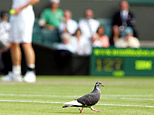
Wimbledon under fire for pigeon cull

Go pigeons! :)
-----------------
LONDON, June 24 (Reuters) - Wimbledon came under fire from animal activists on Tuesday for using marksmen to shoot down dive-bombing pigeons.

The tournament employs two hawks to scare away pigeons who had become a pest swooping down on Centre Court and distracting players in the middle of tense matches.

But the hawks failed to keep the pigeons away from the players’ lawn and the open-air media restaurant so marksmen were called in.

“The hawks are our first line of deterrent, and by and large they do the job,” Wimbledon spokesman Johnny Perkins said.

“But unfortunately there were one or two areas where the hawks didn’t deter the pigeons, so it was deemed necessary to take a harder approach,” he explained.

The marksmen were summoned by Wimbledon as pigeon droppings on the restaurant tables were thought to be a health hazard.

The decision to call in the marksmen was condemned as “cruel and illegal behaviour” by People for the Ethical Treatment of Animals (PETA) which complained to the tournament organisers and the police.

“Since the use of marksmen to kill pigeons appears to have been carried out as a first, rather than a last resort, and not out of a concern for public health, but rather because the animals were deemed inconvenient by players, you appear to be in clear violation of the law,” PETA vice-president Bruce Friedrich said.

SOURCE: Yahoo

Friday, June 27, 2008

Top-seed Ana Ivanovic is ousted at Wimbledon


WIMBLEDON, England - Top-seeded Ana Ivanovic was knocked out in the third round of Wimbledon on Friday by 133rd-ranked Zheng Jie of China, extending a spate of stunning upsets at the All England Club.

ADVERTISEMENT

Ivanovic, who took over the No. 1 ranking after winning the French Open earlier this month, slumped to a 6-1, 6-4 loss to the wild-card entry and doubles specialist.

Ivanovic, who saved two match points before overcoming Nathalie Dechy in three sets on Wednesday, had no answer for the hard-hitting Zheng.

"It's a surprise for me," said the 24-year-old Zheng, who won the Wimbledon doubles title in 2006. "Thanks to Wimbledon, (which) gave me a wild card. I just tried my best and had to keep going, going."

Ivanovic went out a day after 2004 champion and third-seeded Maria Sharapova was ousted by 154th-ranked Alla Kudryavtseva and two-time men's runner-up Andy Roddick was bounced by Janko Tipsarevic. A day earlier, Australian Open champion and No. 3-ranked Novak Djokovic fell to Marat Safin.

Ivanovic committed 17 unforced errors, converted only one of seven break-point chances and lost serve four times. She could lose the No. 1 ranking depending on how far No. 2 Jelena Jankovic and No. 4 Svetlana Kuznetsova advance in the tournament.

The match ended with Zheng's serve hitting the service line and Ivanovic shanking her forehand return into the Court 1 stands.

"She played really well today and it was a tough match for me," Ivanovic said. "I'm disappointed with my loss but I still look at it as a learning experience.

"It was a very emotional last couple of weeks for me and it took a bit of a toll," she added. "I didn't have great preparation."

Zheng has won 11 tour doubles titles, including the 2006 Wimbledon and Australian Open championships with Yan Zi. She has captured three career singles titles, in relatively small events at Hobart in 2005 and Estoril and Stockholm in 2006.

In 2004, Zheng reached the round of 16 at the French Open to become the first Chinese woman to make the fourth round of a Grand Slam. She reached a career high singles ranking of No. 27 in 2006.

SOURCE: Yahoo

Forgot all about this... Classic


By CHARLIE WYETT

Published: 21 Jun 2008

MIKHAIL YOUZHNY wants the Wimbledon docs on stand-by — in case he suffers another rush of blood to the head.

The Russian stunned the tennis world when he smashed his racket against his head THREE TIMES after missing a routine shot — causing the claret to gush down his face.

The world No17 needed treatment on court during his match against Nicolas Almagro in the Sony Ericsson Open in Miami.

Youzhny is now preparing for the first round at the All England Club despite injuring his neck in two places in a freak accident while exercising.

And the Moscow-based fruitcake refuses to rule out a repeat of those madcap antics if he gets stressed during a match.

He said: “When I was a kid I had big problems with my behaviour. It is common among players. One guy who coached me says the older Youzhny is fine but the younger brother Mikhail was crazy.

“I broke rackets and I cried. I’d then shout at my family during matches. Growing older, I changed.

“However, I don’t really like this tournament in Miami. I have never felt comfortable in this tournament. I don’t tend to win matches there.

“I don’t know why. I feel something bad — there is too much negativity around there.

“Before the match I felt negative, during the match I felt negative and after the match I felt negative. I was suffering inside.

“I tried to do my best but I was making so many mistakes. I had break point on his serve, missed the chance and hit the frame against my head a little bit. Three times.”

Laughing about the April incident, he added: “It’s not something I had done before.”

Asked if he’d do it here, he said: “When you watch football and your team is losing, you get the phone and throw it against the wall.

“Some people say they won’t do it again but they watch another match and they do the same thing. It is all about emotions but it is not something I plan to do all the time. But, I can’t say I won’t do it.

“Thankfully in Miami, there was a physio very near. At first I didn’t feel the blood but then I realised I had to go to my chair.

“After that, I felt I had released all the negativity. I won the match.”

Youzhny, 26 on Wednesday, plays Argie Sergio Roitman first up.

The Russian started the year impressively, thrashing Rafael Nadal 6-0 6-1 in India and then reached the Australian Open quarter-finals.

But he has since struggled with his freak injury. He said: “I hurt it while exercising. It restricts me when I raise my arms but I can play.”

SOURCE: The Sun

Thursday, June 26, 2008

Roddick out at Wimbledon!


WIMBLEDON, England (AP)—Sixth-seeded Andy Roddick has been upset in the second round at Wimbledon, losing to Janko Tipsarevic of Serbia.

Roddick, who lost the 2004 and 2005 Wimbledon finals to Roger Federer, was beaten 6-7 (5), 7-5, 6-4, 7-6 (4) by 40th-ranked Tipsarevic, who has never gone past the fourth round at a major.

Roddick reached the semifinals at the grass-court tuneup event at Queen’s, coming back from a shoulder injury that forced him out of the French Open.

He had three set points in the fourth to pull even and eight breakpoint chances overall, but Tipsarevic saved them all.

SOURCE: Yahoo